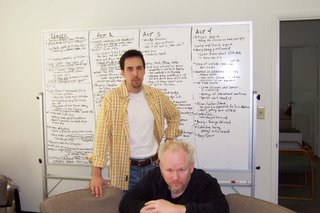
 (<-- Show-creators and exec-producers Andy Cosby (bottom) and Jamie Paglia glare at me as I dick around insead of pitching.)
Well, Spec-monkeys, time to crack open the door a little. I've got to talk to Cosby today about how many details we can spill while discussing the ep -- and Lord knows if we'll actually shoot the bastard -- but I figure a quick look at writing a freelance
Eureka might be useful. Rather than do a summary after it's all done, I figure a pseudo-real-time approach might be interesting. So I'm going to get you caught up to where we are now, and then do regular updates so you can get a sense of time-scale on TV production.
I've got a bit of a cheat as an in. Cosby's one of my oldest and best friends in LA. We met when he and Ross Richie were producing the
Mage movie. (... must ... move past ... pain) I'd read every draft of
Eureka on the way to shoot, not to mention some bull sessions with Cosby, so I knew the tone and style he was going for, not to mention the overall mystery arc. A couple loose moments in the pilot are actually my caffeine-fueled pitches. Cos asked if I'd like to take a run at one of the episodes. We set a date for me to come in and pitch out an idea to the staff.
Despite my cushy
Brokeback-SanDiegoCon in on the staff, I attacked the episode the same way I would any other. When you're pitching a freelance, no matter who you are, it better sing.
Every good television episode is revelatory of the characters. The sci-fi McGuffin should serve to illuminate character relationships. If, when you get to talk to your first executive producer, you focus on how your ideas will focus on reflecting some aspect fo the characters, you can't go wrong. The room will come up with the plot bullshit -- you need to bring the heart. If in particular you're able to showcase some characters who are not always used to their maximum effect, aces.
You are there to solve the exec-producer's problems. Sometimes problems he didn't know he had.
It's crucial, too, to know the theme of the show. Not the genre, the theme.
Eureka is scifi, but as the logline in the promo said: "Small Town. Big Secrets." The small-town focus of the show carries with it a lot of emotional and stylistic freight.
And so a few weeks later we have --
Meeting One: I sit at the end of a long table, with the six writers of Eureka waiting. After small talk, I jump in. The story really focuses around two sentences:
a.) In the stereotypical image of a small town, everybody knows everything, about everybody. Nobody has any secrets.
b.) Bullshit.
Nobody knows anybody. All relationships are based on what our perceptions of other people are. Mutually agreed-upon lies, that sort of thing.
For the character engine, we start with Zoe, the new girl in town, who's finding it impossible to fit in. Both she and her father, Carter, the new Sheriff, are the new people in town. (and, conveniently, Carter is the series' defalut viewpoint character) Zoe's a hip big-city teen, and all the people of Eureka have been living in each others' hip pockets for their entire lives. Everybody knows everybody else, it's a big family. As nice as they are, no room for the new girl.
Through the sci-fi MacGuffin (which we'll discuss a bit later), that illusion is blown. ALL the characters learn fragments of each others' secrets, and all of them give up some of their own. Some of the secrets completely change the way we think of a character, or at least bend it. By the end of the episode --
-- Character backgrounds and relationships have been explored, and some advanced
-- We've advanced some meta-plot business, as some people's secrets that are revealed relate to the overall mystery of the show
-- and Zoe is in a new place in her relationships with her fellow townspeople.
All this gets puked up in a straight-run pitch. Theme, teaser summary, act, act, act, act and out. I tend to focus on the Act-outs as they show you what the stakes are, how they elevate -- regardless of how you wind up executing the story, the act-outs work as the framework for me in terms of pacing and story-structure.
This may reveal my old pulp roots, but for a sci-fi/genre show, my rough stucture is:
1.) Wow, have we got a problem. It is Very Bad.
2.) Whoops, no, we have an entirely different problem, and it's far worse.
3.) That problem? Yeah, that's going to kill us.
4.) Solve the problem. Marvel at the emotional wreckage. Prep for next week.
Really, you've got 48 minutes. 6 two-minute scenes an act. TV isn't haiku, but it's damn close.
This is not to say the pitch is
vague. You know what happens, you know how it affects the characters, and for me, the important thing is we stop and mention how the characters interact with each other as the story progresses. This first pitch is the answer you'd give if somebody asked you to describe an episode of TV from last night in as much detail as you could, but in three minutes. (This'll become clearer once I check and see how much I can toss up on the site, indicating the level of documnetation at each stage)
So I run straight through the episode. Hurdle one: the writers dig it. Everybody gets what the emotional story is, and how this'll help set up further episodes. Now the questions: How does the scifi work? How do we make it clear? What are each of the main characters doing so none are sitting around with their thumbs up their ass for half the episode? At this point somebody points to the Big Board -- the Board every writers' room has, of all the different ideas they have about the show, be they character, plot, gimmick -- and indicates how a few of the things they've been talking about showcasing can be slid into this episode.
What's tricky in this situation is that no episodes have been shot. Even the staff is figuring out -- how does Character X feel about Character Y? If I were in pitching a
House, for example, I could write Chase/Cameron dialogue in my sleep. Here, you need the staff to fill you in on what will work and won't. Some of my pitch needs to be tweaked with the addition of a new character coming in on Episode Two.
With these notes, I'm sent off to prep for the next time I'm in the room -- the
Story Breakdown. Right now, we know the beginning, middle, and end of the episode, both story and character, but we haven't quite nailed down how it's going to get from Teaser to blow. Next time, we'll map out how we travel that road beat by beat.
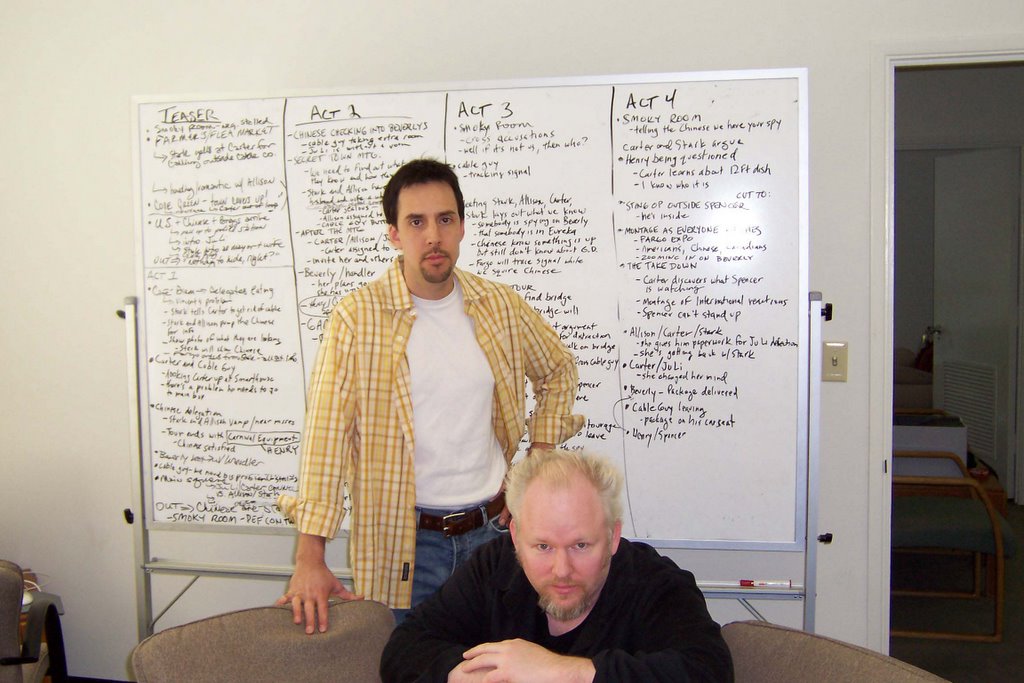 (<-- Show-creators and exec-producers Andy Cosby (bottom) and Jamie Paglia glare at me as I dick around insead of pitching.)
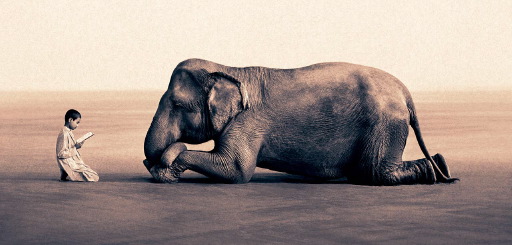 Just got back from this exhibition on on the Santa Monica Pier, and I can't recommend it enough for anyone within reasonable driving distance.
